Somatic Ledger Log 1.1: Moving Beyond the Mechanical Body
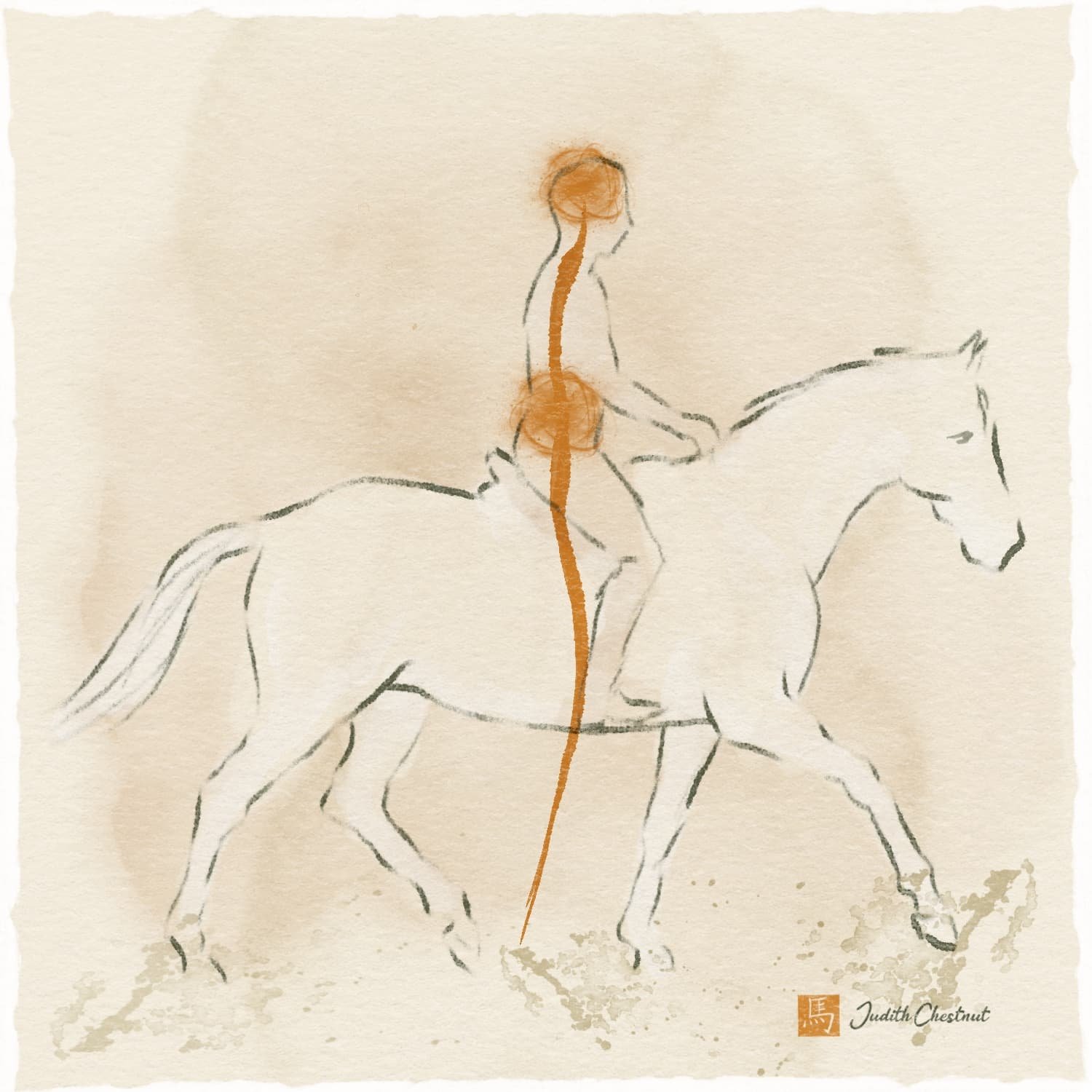
The Reawakening Axis
Somatic Study Log 1.1: The re-awakening central nervous system finding its internal vertical spine amidst habituated neuromuscular noise.
In the opening of Somatics, Thomas Hanna makes a vital distinction that redefines how we look at physical movement: the difference between "the body" and the "Soma". The body is traditionally viewed as a static, mechanical object observed from the outside—an anatomical machine to be corrected, shaped, or forced. A Soma, however, is the body experienced from within by the individual person. It is entirely subjective, living, and breathing.
When we step away from rigid, competitive training models, we realize that true physical liberty isn't about satisfying an external onlooker ; it is about cultivating this deep, internal self-perception.
This shift in awareness completely changes how we interpret stiffness or resistance, whether in ourselves or in our horses. When a horse like Montana exhibits stiffness, traditional training frames it as a structural failure or a lack of effort. Through the lens of the Soma, we see the real culprit: Sensory-Motor Amnesia (SMA).
SMA occurs when the central nervous system loses the ability to feel and control specific muscle groups due to habituated stress or repetitive trauma. The brain literally "forgets" how to relax these tissues, keeping them chronically locked. When a rider carries their own "Tower of Pisa" alignment into the saddle, a horse acts as a flawless neurological mirror. They intercept our hidden tension, adaptively bracing their own spines to carry us.
Stiffness is rarely permanent structural damage; it is a functional state of amnesia that must be gently re-educated, not forced. Physical decline is not an inevitable consequence of aging—it is simply the cumulative, uncorrected buildup of SMA over time. Because it is a learned habit of the nervous system, it can be unlearned.
To release this physical "handbrake," we cannot simply pull harder or try to force a straight posture. Re-education requires deep, unhurried environments that speak directly to the motor cortex.
This is the ultimate purpose of dedicated floor work and meticulous scans at the ballet barre. By tracking our movement loops slowly and intentionally, we map out where our nervous system has developed blind spots. We use these movement patterns as diagnostic tools to consciously engage and then completely dissolve muscular noise before our feet ever hit the stirrups. We step into the arena not to fix a mechanical machine, but to share a state of mutual somatic clarity.