Foundations
The Architecture of Presence
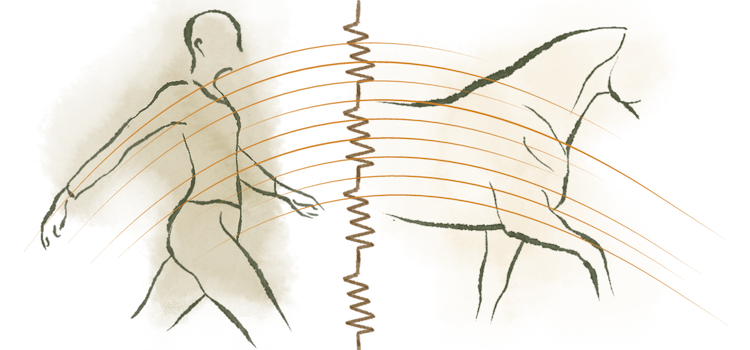
True movement rehabilitation does not live in performance, coercion, or mechanical repetition. It lives in the quiet territory of neuro-somatic clarity. When we strip away the artificial demands of traditional performance models, we find that both the human and equine nervous systems are governed by the same biological laws: rhythm, structural alignment, and a shared capacity for release.
This page serves as a conceptual map—an anchor for a studio practice dedicated to somatic restoration. By weaving together the precise science of Auditory-Motor Entrainment with deep somatic awareness, we find a steady, unburdened thread that bypasses defensive habituation and invites both bodies back to structural integrity.
Releasing the Handbrake: From Bracing to Remembering
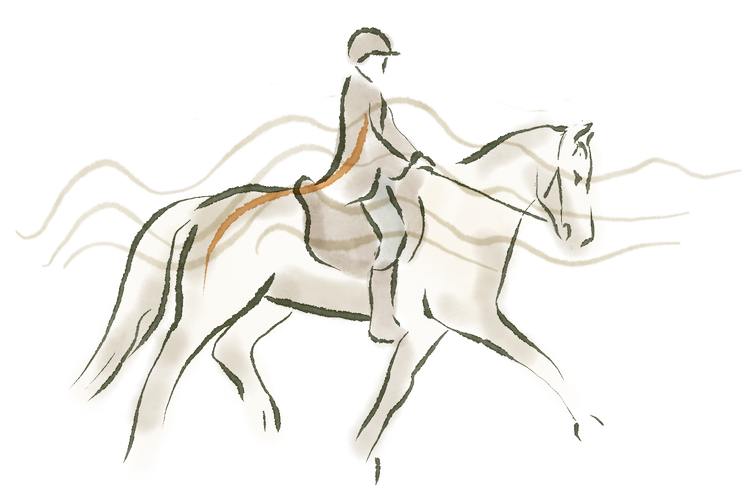
Under the pressure of chronic stress, mechanical overloading, or repetitive trauma, the nervous system defaults to survival. It initiates a subcortical, defensive bracing pattern—a subconscious tightening that eventually becomes deeply habituated. This state is known as Sensory Motor Amnesia (SMA). The brain has quite literally lost the functional map required to relax these deeply held muscles. It is an internal handbrake, locked in place.
We cannot force this handbrake to release through aggressive physical stretching or mechanical coercion; doing so only triggers a stronger protective reflex. Instead, we must speak directly to the motor cortex. Through deliberate, slow, and self-sensing movement patterns, we offer the nervous system a clear window of safety. We move away from blind execution and step into somatic remembering, allowing the body to gently rediscover its natural, unburdened length and structural integrity.
Interspecies Pandiculation: The Dialogue of Release
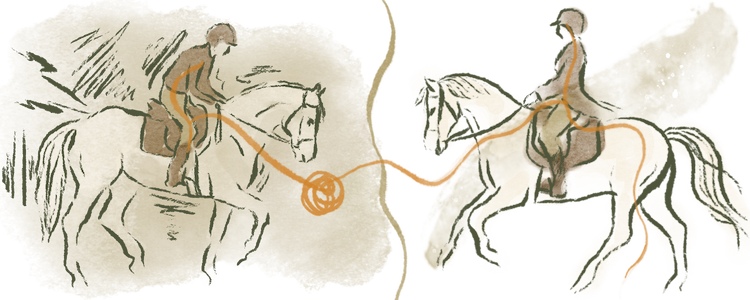
Pandiculation is the biological expression of the self-sensing myofascial system. It is the natural mechanism through which a nervous system wakes up its motor maps and clears accumulated tension. In a studio practice dedicated to genuine restoration, we do not view the horse as a mechanical frame to be sculpted or micro-managed through continuous physical aids. Instead, we acknowledge that a horse acts as a highly sensitive neurological radar, perfectly mirroring the muscular realities of the human standing beside or sitting above them.
True lightness begins when we offer a quiet, neutral operational baseline. By executing a conscious, deliberate "Somatic Sigh"—a voluntary, deep neuromuscular release starting at our own psoas-diaphragm nexus—we create a resonant somatic anchor. Bypassing the friction of top-down correction, this intentional human release alters the shared physiological field. It dissolves environmental static and triggers a parasympathetic cascade that invites the horse to drop its own defensive alertness, mirror the release, and enter a shared state of restored equilibrium.
The Rhythmic Shield: Auditory-Motor Entrainment
True biological symmetry requires a shared temporal foundation. When a movement practice relies purely on continuous, manual correction, attention becomes fragmented and defensive stiffness is easily reinforced. To override this habituated noise, we introduce a precise 110 BPM rhythmic template. This external cadence activates the brain's capacity for Auditory-Motor Entrainment, a pre-programmed neural mechanism where the motor system instinctively adjusts its timing and activation patterns to align with a predictable auditory beat.
This steady cadence functions as a rhythmic shield. It standardises the allocation of our attention, providing a non-coercive timeline that structures the human movement scan before we ever approach the horse. By moving to this shared cadence, we establish a quiet, unwavering structural axis. The predictable cadence overrides subcortical alertness, allowing the equine nervous system to match our rhythmic clarity, dissolve protective posture habits, and step into a fluid, self-correcting equilibrium.